Turin
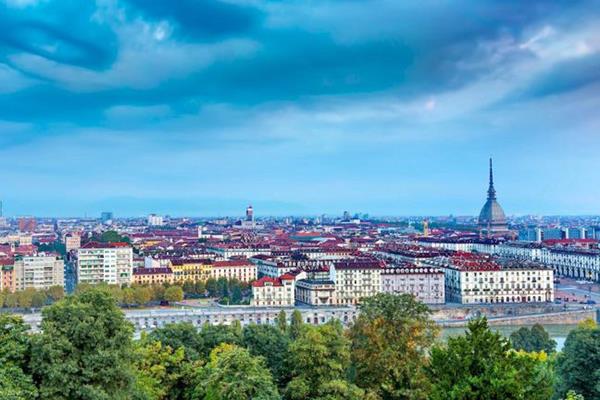
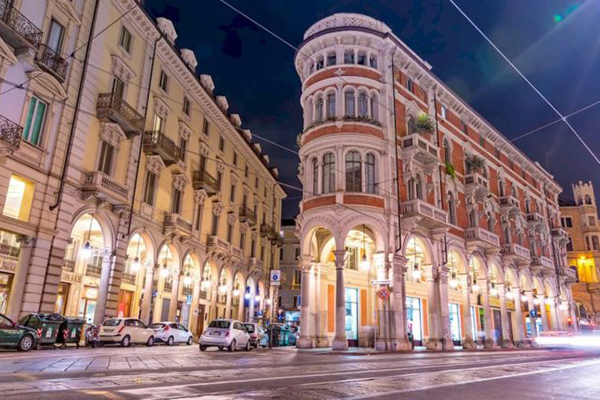
Turin is one of the largest cities in Italy and the capital of the Piedmont region. Located on the river at the foot of the Western Alps an hour's drive from the border with France and about the same distance from the Mediterranean coast. Turin is a sophisticated city with wide streets, squares, palaces and a unique metropolitan atmosphere. It stands out architecturally and culturally among all Italian cities and is of great historical importance. Turin is the first capital of united Italy, the cradle of Risorgimento, a national liberation movement for unification and freedom.
The city has long been the main residence of the mighty Savoy dynasty. During the heyday of the splendor of architecture, he competed with Paris and Vienna. Magnificent palaces and many beautiful buildings in Baroque, Rococo, Neoclassic and Modern styles. In addition Turin is the capital of the 2006 Winter Olympics and one of Italy's major industrial centers.
The Antonelllian mole is one of the symbols of Turin a 19th-century tower with a 168-meter spire. Construction of the structure began in 1863 by Alessandro Antonelli. It was planned that a synagogue would be located here. Now there is a movie museum, and the tower offers stunning views of the surrounding area.

History
Initially on the site of modern-day Turin there were settlements of Celts and Ligurians. In the 1st century BC Julius Caesar founded a military camp here which was renamed Augusta Taurinorum in August. After the fall of the Western Roman Empire Turin came under the control of the Lombards and later the Franks.
In the 13th century the city became part of the Savoy dynasty and in the 16th century acquired the capital status. This time is the true heyday of Turin. Palaces and beautiful monumental buildings are being built here. During the Spanish War the Duke of Savoy defeated the French and took the title of Kings. Turin is on par with other capitals in Europe.
In the 19th century, Turin became the "cradle" of the national liberation movement which aimed at the liberation and unification of Italy. The city was also the capital of the country for some time. Currently Turin is one of the largest industrial technological and cultural centers of Italy.
Geography and climate
Turin is located in the northwestern part of the Pada Plain at the confluence of the Dora-Riparia and near the Alps. The Po River divides the city into a flat and hilly part. The climate is temperate with very hot summers and mild winters. The average January temperature (the coldest month) is about 1 degree with a plus sign. Most precipitation falls from April to June.
How to get there
Turin International Airport is located 15 km north of the historic center. The major carriers are Lufthansa, Air France, Turkish Airlines and Alitalia. From the airport to the center can be reached by train or bus. The sadem bus runs every 15 minutes (30 minutes every Sunday) from the airport to the Porta Nuova train station.
Turin is a large railway junction. There are three train stations (stations). The Porta Susa station serves trains to the northern regions of Italy (Milan, Venice, Aosta, and Paris) and Porta Nuova serves trains to the south (Genoa, Florence, Rome, Bologna). The city has excellent car accessibility. The A4, A5, A6, A21 and A32 motorways pass by.
Cuisine
In the historic center of Turin you can easily find establishments for every taste and purse. There is a high concentration of bars, clubs, cafes and restaurants in the San Salvador area. From the traditional (Piedmontese) cuisine, the following dishes are popular:
Agnolotti del plin - stuffed pasta
Gnocchi alla bava - pastry with tomato and cheese
Tajarìn - thin pasta with egg yolk
Messer Agnolotto
Vitello tonnato - thin veal slices with sauce
Turin in terms of shopping is certainly not Milan. But here you can find many stores both inexpensive and branded. Turin's main shopping areas:
Via Roma (from Piazza Castello to the train station) - from Gucci and Prada to H & M.
Via Garibaldi-Turin says it is Europe's longest shopping street.
Via po and Via Pietro Micca.
Shopping
Sights
The Antonelllian mole is one of the symbols of Turin, a 19th-century tower with a 168-meter spire. Construction of the structure began in 1863 by Alessandro Antonelli. It was planned that a synagogue would be located here. Now there is a movie museum and the tower offers stunning views of the surrounding area.
Basilica of Superga is a cathedral on a high hill east of the historical part of Turin. It was built in 1731 in honor of the victory over the French. It has beautiful Baroque architecture rich interior decoration and has many columns. The Basilica is the burial place for members of the Savoy Dynasty. It offers stunning views of the surrounding countryside with the Alps in the background. You can get upstairs both by car and by train.
San Giovanni Battista is a fine example of Renaissance architecture a cathedral built in the late 15th century and dedicated to the patron saint of the city. The facade is made of white marble and a bell tower is made of bricks. You can climb the tower. Inside you can admire the fantastic frescoes and marble statues of famous religious figures. The main attraction of the cathedral and one of the main Christian shrines is Santa Sidone or the legendary Shroud of Turin, the shroud into which the body of Christ was wrapped. The shrine is located in a closed chapel and is not accessible to the public.


